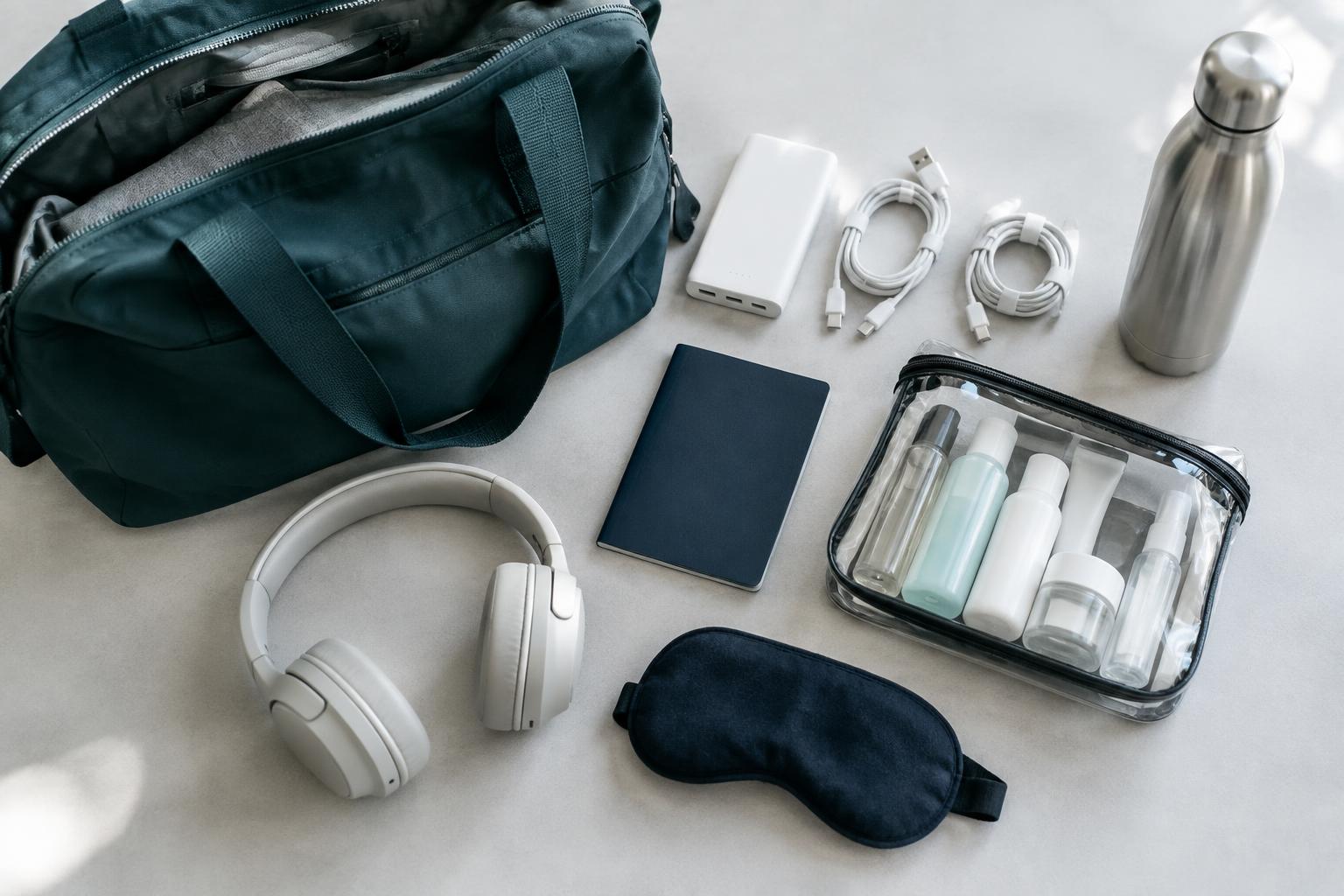
Keep documents secure and accessible
Carry your passport or other required identification, tickets or boarding passes, and any entry documents your destination requires. Check passport validity and visa requirements before departure; these depend on your nationality, destination, and transit route.
Keep documents in a secure, easy-to-reach pocket. Save useful booking details offline and consider a separate paper backup. A copy of a passport is useful as a reference but does not replace the original document. Avoid exposing document details in luggage tags.
Pack charging cables and a suitable power bank
Bring cables that match your devices and a compatible charger. Check the voltage requirements of your equipment and whether you need a plug adapter at your destination. An adapter changes the plug shape, not necessarily the electrical voltage.
Choose a power bank with clearly marked capacity, compatible ports, and enough charging capability for your needs. Airline rules vary, particularly for batteries: check current capacity limits, permitted quantities, approval requirements, and restrictions on using or charging power banks during the flight.
- Keep power banks and spare lithium batteries in your cabin bag as required; do not put them in checked baggage.
- Protect battery terminals against short circuits and avoid damaged or recalled batteries.
- If your cabin bag is gate-checked, remove power banks and other items the airline requires to remain with you.
Take essential medication and a small toiletry kit
Keep essential medication accessible, preferably in original labeled packaging. Bring prescriptions or supporting documents when required, and check restrictions for your destination and any transit countries. Ask a pharmacist or clinician about temperature-sensitive medication and time-zone changes; do not improvise a dosing schedule.
For toiletries, take only what you will use: a toothbrush, a small toothpaste, and a few personal essentials may be enough. Liquid container limits and screening procedures differ between airports and countries, including return and connecting journeys. Check the relevant airport or security authority as well as your airline.
- Check how medically necessary liquids and related supplies must be declared at security.
- Use securely closed containers and a compliant liquids bag where required.
- Do not assume a newer screening system at one airport means every airport has the same rules.
Bring a reusable water bottle where permitted
An empty reusable bottle can be useful where airport and airline rules permit it. Empty it before screening when required, then refill it at a designated drinking-water station if one is available. Check local water safety instead of assuming every tap is suitable.
Choose a bottle that seals reliably and fits the bag pocket you intend to use. Leave it accessible without placing it above documents or electronics that could be damaged by a leak.
Choose a few comfort items you will actually use
A light layer can help in a cool cabin. Earplugs, an eye mask, and headphones may make resting easier, while a travel pillow is worth carrying only if its support and packed size suit you. Download reading or entertainment before departure.
Consider a small snack if permitted by your airline and destination’s food import rules. Bring a change of underwear or a spare top if checked baggage delays would leave you without essentials. Avoid packing so many comfort items that your bag becomes awkward to lift or carry.
Check the bag before you leave
Check both the size and weight of your carry-on and any personal item. Some airlines allow two pieces; others have different allowances by fare or route. Put frequently needed items in one accessible pouch and leave enough space to remove electronics or liquids for screening when requested.
Airline and airport requirements can change. Review current guidance for every leg of your trip rather than treating a generic packing checklist as permission to carry a particular item.
The takeaway
A useful carry-on is personal, compact, and organized around essentials. Keep documents, medication, and permitted batteries with you, then add only the comfort items that earn their space. Check current airline, security, and destination requirements so the bag works for the whole journey.